Friday, 19 February 2016

Dreadnought (I) - Montaje y preparación


Con este post inauguro una pequeña serie que tiene como objetivo mostrar un paso a paso del Dreadnought.
El motivo de este paso a paso es que me he apuntado al concurso organizado por Troll Workshop en el foro Atalaya, podeis seguirlo desde este enlace.
La idea es que cada semana se deben mostrar una serie de pasos, esta semana toca Montaje y preparación.

En este caso la miniatura elegida es un Dreadnought de plástico de la caja de Betrayal at Calth. En realidad tengo dos dreadnoughts y en los dos he seguido un proceso similar por lo que probablemente cuando termine este seguiré con el otro modelo.

El problema básico es que el Dreadnought tiene una pose muy estática asi que decidí dividirlo en piezas y ponerle una pose mas dinámica. Además utilicé imanes para los brazos para poder montar diferentes configuraciones de armas, especialmente al combinarlo con los brazos del otro Dreadnought.

Estuve buscando bastante información sobre otras personas que hayan hecho la misma transformación y al final encontré un buen paso a paso aquí.

Las herramientas utilizadas fueron:

  • tenacillas
  • cutter
  • super glue
  • taladro manual
Lo primero que hice fue sacar todas las piezas de la matriz usando las tenacillas y eliminar todas las líneas de molde usando el cutter. Después hice un agujero en todas las bocas de las armas asi como en los tubos de escape.

Una vez tuve todas las piezas separé la pierna derecha, el torso y la cabeza. Todo esto con mucho cuidado y con el cutter, ya que especialmente la pieza que une el torso es frágil.
En esta foto se puede ver las piezas una vez separadas junto a un cilindro de plasticard que haría de unión de las dos piezas del torso.

Todos los componentes sacados de la matriz

Una vez las piezas estuvieron separadas, me dediqué a añadir detalles con masilla verde en algunas, como escudos, ojos de horus y pergaminos.
Añadí algunos agujeros con el taladro para simular impactos de bala y desgaste en la armadura.
Pegué todos los componentes con super glue y puse imanes en los hombros para poder montar diferentes armas.
Para unir las piernas y el torso utilicé un pequeño cilindro de plasticard sobre el que las piezas pueden rotar. Una vez pegado modelé con masilla la unión.
Finalmente hice un agujero en uno de los pies para poder pinear la figura a la base.

En la siguiente foto se puede ver la base. Está hecha de forma similar a las del resto del ejército. Sobre una base de varias láminas de corcho he puesto plasticard para simular restos de paredes o de suelo y he añadido detalles de una defensa anti tanque (un erizo checo) y alambre de espino. Después le he dado una capa de Oxid Paste sobre la cual he puesto arena de playa y algunas piedras mas grandes. Al darle la capa de Oxid Paste aproveché y puse un poco en la parte de abajo de las piernas para simular restos adheridos a la armadura.

Base y piezas principales del Dreadnought
Detalle del pergamino de la parte de arriba

Una vez se secó la masilla verde, monté el torso con las piernas y dejé separados los brazos y la peana para poderlos pintar por separado.

Aquí unas fotos del Dread apoyado en la peana, para que se vea cómo queda el conjunto.


Lo siguiente es imprimarlo en negro. El pintado estará inspirado en estas ilustraciones sacadas del libro Betrayal de FW. Básicamente mezclando verdes, negros y desgastes de batalla. En el otro Dreadnought que estoy montando he puesto cadenas como en la segunda ilustración.


Friday, 29 January 2016

Prueba de color para Hijos de Horus

Por fin tras mas de un mes montando legionarios de la caja de Betrayal at Calth he podido sentarme a realizar la primera prueba de color.

Gracias a las experiencias de otros ejércitos tenía claras las siguientes cosas:

  • el color base no debía ser mezcla de varios
  • el tiempo de pintado tenía que reducirse al máximo manteniendo un resultado bueno
  • la paleta tenía que ser reducida
Teniendo esas ideas claras y tras haber leído muchos posts sobre cómo pintar las miniaturas de Herejía me puse manos a la obra.

Color base

Lo primero que hice fue descartar la receta de pintado de Hijos de Horus de Forgeworld, la podeís leer vosotros mismos. Es una locura en la que se mezclan cuatro tipos de verde sólo para la capa base, en este post hay un paso a paso bastante bueno que te explica cómo usar esa receta, pero como se puede ver, es un proceso largo y complejo, aunque el resultado sea bueno.

Seguí buscando recetas de pintado sin éxito ya que la mayoría de la gente usa mezclas, hasta que tuve la suerte de leer este post en el foro de Bolter and Chainsword donde hay unas fotos de unos legionarios con un color verde muy conseguido que decía utilizar simplemente dos colores directamente del bote de Vallejo. Este parecía el candidato adecuado, me compré los dos botes, hice unas pruebas de color y la verdad que me convencieron, ahora podeís juzgarlo vosotros.

Como inspiración he utilizado también este blog en el que va escribiendo artículos a medida que pinta su ejército y en estas fotos de Warhammer World en el que se ven legionarios suficientemente de cerca para apreciar todos los detalles.

Paleta

Como he dicho antes, la paleta tiene que ser reducida. Para un ejército numeroso ayuda a la cohesión y especialmente en este caso en el que hay muchas pequeñas conversiones no quiero dar un aspecto caótico, sino el de un ejército curtido en batallas, con veteranos y en mitad de una campaña.
Por lo tanto la paleta se reduce a lo siguiente.
  • Para los grises: German Grey Model Color, Wolf Grey de Army Painter, Wolf Grey Game Color y Bonewhite Game Color.
  • Metálicos con Gunmetal Model Color y Silver Game Color.
  • Tintas y sombras con Coelia Greenshade Citadel y Dark Tone de Army Painter.
  • Verdes con USMC Tank Crew Panzer Aces y USMC Highlight Panzer Aces.
  • Rojos con Parasite Brown Game Color, Plague Brown Game Color y Mephiston Red Citadel.
Grises
Metálicos
Tintas
Verdes
Rojos

 Receta

La receta de pintado es sencilla, hay que tener en cuenta que tengo que pintar unos 80 legionarios, asi que no podía hacer muchas florituras. Es por eso también que descarté utilizar NMM, ya que no sabría bien cómo aplicarlo a tanques y Dreadnoughts.
  1. Capa base negra
  2. Gunmetal para los metálicos
  3. USMC Tank Crew para los verdes
  4. German Grey en la peana
  5. Capa generosa de Dark Tone en la peana y metálicos
  6. Lavado con Coelia Greenshade en la armadura
  7. Pintar la peana: pincel seco generoso de Wolf Grey y luego muy ligero de un gris mas claro
  8. Repasar armadura con USMC Tank Crew
  9. Iluminar metálicos con Silver
  10. Pintar detalles: ojos, granadas, etc...
  11. Iluminar armadura con USMC Highlight
  12. Pintar símbolo de Horus
  13. Aplicar desgastes: desconchones, marcas de óxido
  14. Pigmentos en peana y piernas
  15. Barnizar en mate
Todo este proceso me llevó unas 3 horas aproximadamente partiendo de la miniatura ya imprimada. Creo que puedo rebajarlo cuando pinte en cadena, lo siguiente que tengo en la lista son 14 legionarios de la misma escuadra así que pronto se podrá comprobar.
A continuación os enseño las fotos incluyendo pasos intermedios, están hechas con el móvil porque haré otra ronda de fotos en la caja de luces mas adelante con el resto de la escuadra.

Miniatura recién montada (es diferente de la que pinté finalmente, no me di cuenta y no le hice foto antes de imprimar). En la peana he usado Oxid Paste como con mis skavens.
Estado de la figura en el paso #3


Estado de la figura en el paso #6, con el lavado recién aplicado

Estado de la figura tras dejar secar el lavado del #5 y #6, se aprecia que el tono de verde ha bajado un punto.
Estado de la figura tras el paso #12

Resultado final


Notas finales

Se puede comprobar que el resultado final no es espectacular pero cumple para tabletop.
Hay bastantes cosas a mejorar pero estoy razonablemente sastisfecho para ser la primera. Me he dado cuenta que el lavado en el paso #6 fue demasiado generoso asi que lo tendré que diluir un poco.
Adicionalmente los ojos se ven demasiado apagados asi que tendré que trabajarlos mas y los desconchones en algunos casos son muy pobres o con trazos muy gruesos asi que me tocará seguir mejorando.
Pintado en 2016.
¡Espero vuestras opiniones!

Tuesday, 5 January 2016

Warhammer Armies 3rd ed.: A review

This is my first post of 2016, although to be honest it was left in a draft stage for a couple of weeks since December, waiting for the last review after the xmas break.
I hope to be able to post some miniatures painted by the end of the month!

Along with my copy of the Warhammer Fantasy 3rd ed. rulebook I managed to grab as well the great Warhammer Armies, which is a compendium of all the possible armies you could use with 3rd ed.

For the same reasons I did a review of the rulebook, I wanted to make another of the Armies book, basically, because I did not find any overview when I looked for information a while ago.
Disclaimer: This is not a comprehensive review and it contains only my opinion. It might also contain errors or missing information, this is only intended as a brief overview of the book for players who know 4th or 5th edition for example.

The book

The copy I have is a hardcover version, not sure if they ever published a softcover one.
It is roughly half of the size of the rulebook, as it has around 170 pages.
The book is decorated with black and white art, and some coloured pages here and there with a strong  feeling of the 80s.

Introduction

Contents of the Introduction
This section is covered in just one single page, with some basic recommendations. They suggest using the lists 'as is' only for 'purist' or tournament-like games, and having some degree of flexibility.
There is also the mention of extra armies not covered by the book that might be covered in a White Dwarf in the future.

Special Rules

Contents of the Special Rules
These section adds or modifies some rules from the rulebook.
For example the points for elite troops are reduced to encourage their usage, so it is not something that the 'new GW' has invented :)
Some new rules are added for new kind of troops, such as the Wardancers and War Altars.

Magic


Contents of Magic
The magic section includes an important clarification on the number of wizards that can be used by each army, to try and make the game a bit more balanced.
Also the cost in magic points of many spells were adjusted, and they are listed here.

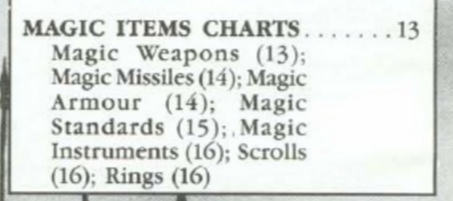
Magic Items Charts


Contents of Magic Items Charts
All the magical equipment for all armies is listed in this section, where many new objects have been added and the old ones have been adjusted.
Again you can see an effort in balancing the point costs and taking more steps into the tournament-like or balanced game, the same thing that was applied in the Magic section.

War Machines

Contents of War Machines
This section covers special war machines specific for some armies and their rules.
For example for the Goblobber it explains how it differs from the generic stone thrower.

Bestiary

Contents of Bestiary
This section provides the rules for new creatures that have been added since the publication of the rules.
Keep in mind that the original Bestiary already had over 70 pages, and this adds another 8. The variety and complexity of creatures that you can use in Warhammer Fantasy 3rd is astonishing.
We see the black orcs for the first time here as well as the famous Rat Ogres, that were subject to chaos mutations.

The lists

Contents of the Lists

At last we arrive to the main section of the book, the lists.

It begins with a checklist that you can follow to select your army, which may sound familiar to many Warhammer players but it is slightly different than 4th ed for example. Then there is a very useful example of how to create an army, just to show how to use the book and the previous checklist.
It is worth noting that 3,000 points is the number selected as a 'standard army', which should match the 1,500-2,000 of later editions.
You can see below the composition of the 2,998 points Wood Elf example Army.

Wood Elf example army
Each army list is always divided in the following sections:
  • Introduction with a brief overview of the background of the army
  • Army stats, base size specification, alignment and psychology rules (when applicable)
  • Army Selection limits (such as how many character models you may have)
  • Character Models rules for heroes and wizards, as well as army limits
  • Rank & File (troop rules, cost and composition)
  • Skirmishers (lists who can skirmish and how)
  • Baggage: rules for baggage train
  • Allies: how many points and who can ally with the army
  • Mercenaries: how many points and who can you hire for the army
  • Hosts: lists the hosts that can be bind to the army
The armies listed in the book are:
  • Dark Elves
  • Wood Elves
  • High Elves
  • The Empire
  • Bretonnia (this time with a cannon!)
  • Chaos
    • mixing Chaos Warriors, Marauders and Beastmen but no Daemons
  • Skaven
    • All skavens are subject to mutations, like normal chaos armies
    • Skaven Armies can have up to 6 wizards!
    • We can see photos of Pete Taylor's 3,000 point skaven army in colour
    • Rank & File list
      • Clanrats
        • 0-20 Stormvermin
        • 50-300 Warriors
        • 0-20 Black Skaven
        • 20-500 Skavenslaves
      • Clan Eshin
        • 0-10 Night Runners
        • 0-20 Gutter Runners
      • Clan Pestilens
        • 0-6 Plague Censer Bearers
        • 0-20 Plague Monks
      • Clan Moulder
        • 0-8 Beastmasters
      • Clan Skryre
        • 0-6 Poisoned Wind Gobladiers
        • 0-8 Warpfire-thrower Teams
        • 0-4 Jezzailachis
    • May ally with: Chaos, Orcs and Goblins, Dark Elves
    • No mercenaries allowed
  • Orcs & Goblins
  • Dwarfs (yes, including wizards)
  • Slann
    • Including human slaves as well as the aztec look n' feel that they lost in 5th ed.
  • Undead
Players from recent editions might miss some armies, such as dogs of war, ogres or kislev, that in 3rd ed. are only available as allies or mercenaries. In wikipedia there is an article about the discontinued armies.

After covering the armies, the mercenaries and allies section is listed. As mentioned before, each army may have mercenaries and allies, and in each army section it is listed whom you may ally with.
The first section explains the basic rules to follow when choosing mercenaries or allies for your army, with focus on the loyalty and how to treat it for routing and leadership tests.

Contents of the Mercenaries & Allies
The allies listed are:
  • Chaos with very cool looking chaos goblins, and yes, chaos dwarfs, with the excellent chaos dwarf berserker illustration
  • Dwarf
  • Dark Elf
  • High Elf
  • Wood Elf
  • Fimir
  • Old World: Kislev, Bretonnia and Empire all mixed together
  • Orc and Goblin
  • Pygmy: as far as I know, this army has not been mentioned after this edition, along with Fimir and Zoat.
  • Skaven
    • only as allies, not as mercenaries, you can hire
    • 1 commander
    • 0-1 Clan Eshin Assasin
    • 0-1 Clan Skryre Seer
    • 10-50 Clanrat Warriors
    • 0-10 Clan Eshin Guter Runners
    • 0-3 Clan Pestilens Plague Censer Bearers
    • 0-10 Clan Pestilens Plague Monks
    • 0-4 Clan Skryre Warp Firethrower team
  • Undead
  • Halfling
  • Zoat
After the allies section, the mercenaries are listed.
There are several differences, for example, the loyalty rules are not the same when you use them as mercenaries or allies. Also the selection of troops is different, there are some troops you can have as allies but they are not available to hire as mercenaries.
The mercenaries are:
  • Dwarfs
  • Giants
  • Ogres
  • Half Orcs: this one also disappeared after 3rd ed.
  • Hobgoblin
  • Nippon: also disappeared
  • Orc
  • Norse
  • Old World: not the same as the allies, for mercenaries they are Estalia, Tilea, Empire and Kislev.

My opinion

The book is brilliant.
There is plenty of illustrations, bestiary and descriptions for lots of troops that I have only seen in this book, some I have mentioned above.
The colour artwork is also exceptional and have inspired many armies. You can also notice that some of the additions to armies in the latest editions of Warhammer were inspired by this book, as it contains a wide variety of troops.
Some illustrations are the stuff of legends, such as the "Gaze into the eye of the Warp and Despair" Skaven Standard that appears in every 3rd ed. army inspired by Andy Chambers... and will also appear in my army, eventually!
To sum up, a must have for any lover of oldhammer.

Wednesday, 30 December 2015

Proyectos para 2016

Continuando con el post de los propósitos del 2015, aquí va un pequeño resumen de lo conseguido este año y las propuestas para 2016.

Año 2015

  • Escribir en el blog al menos 50 ó 60 posts
    • Conseguido! He escrito 58 posts
  • Continuar la colección de personajes Horus Heresy
    • Conseguido! Este año he comprado y pintado 4 primarcas.
  • Terminar de pintar el ejército de Iyanden
    • No conseguido. Me he liado con otros proyectos y las pocas miniaturas que me quedan por pintar siguen en la caja
  • Comenzar un ejército oldhammer Skaven
    • Conseguido! Ya tengo pintadas un buen número de ratas y mas que están en proceso, con el proyecto en marcha.
Como resumen, no me puedo quejar, tres de cuatro objetivos conseguidos, aunque haya flojeado en el número de posts en estos dos últimos meses, debido a que apenas he tenido tiempo para pintar.

Hay que decir que por el medio he tenido varios proyectos que se me han cruzado, como el Forbidden Stars, pintar miniaturas sueltas para la banda de Realms of Chaos, etc... pero en resumen ha sido un buen año en la cantidad de miniaturas pintadas.

Ahora veamos los objetivos del 2016, que no van a ser muy originales...

Año 2016

  • Continuar con el blog, de nuevo el objetivo serán 50 ó 60 posts
  • Continuar la colección de personajes Horus Heresy
  • Terminar el ejército oldhammer Skaven
  • Nuevo proyecto: Hijos de Horus
  • Jugar a 30K
Un cambio importante es que elimino de la lista de objetivos el de terminar los Eldar, la verdad que me quedan pocas miniaturas, dos, pero no me planteo como un objetivo prioritario para este nuevo año.

El segundo cambio y el principal, es que comienzo un nuevo proyecto enmarcado en la Herejía de Horus, con un ejército de los Hijos de Horus. Por ahora sólo he comprado la caja básica así que al año que viene espero al menos pintar la caja básica y probablemente ampliar con alguna tropa mas. Como detalle, añadir que quiero jugar al menos una partida a 30K, que este año he pintado bastante pero he jugado muy poco.

Lo seguiré contando por aquí.

Wednesday, 23 December 2015

Warhammer Fantasy 3rd ed.: A Review

I recently bought a copy of the 3rd edition rules of one of my favourite games which is Warhammer Fantasy and one of the reasons why I opened this blog.

As soon as I started to read it I decided I would do a review in the blog, I remember a few years ago when I started to get interested in older versions of Warhammer at the same time as I started to lose interest in newer versions, I could not find a proper review of the rules. I am not saying it does not exist, I was just not able to find it!
To prove me wrong I just found out this article among others from the Realm of Chaos 80s blog that talks about the book.
So there you go, I will try to make a review and try to capture the main points that catch my eye!
Disclaimer: This is not a comprehensive review and it contains only my opinion. It might also contain errors or missing information, this is only intended as a brief overview of the rules for players who know 4th or 5th edition for example.


The book

Let's start with the book itself.
The copy I have is a massive book of 300 pages with soft-cover. If you do not have a copy you can find it in scribd here.
If I were to compare the volume with recent ones, it would be unfair, as the 3rd might excel in rules and background information but the newer ones have brilliant design and are gorgeous to look at. This one is from the early 80s and you can feel it, which one of it's charms anyway.
Nevertheless, let's go over the chapters one by one, shall we?


Chapter 1 - Introduction


Chapter 1 contents
Well, the fact that you have a full chapter of ~20 pages dedicated to just an introduction should already tell you something.
The first few pages are really a traditional introduction, what is a wargame, how to buy, prepare and paint miniatures. But there are some very interesting things hidden in there, such as the recommendation to use acrylic paints as oil and enamel are already out of fashion! I have never seen any other book that needed to state this fact, it's that old :)
Anyway it's nice to see they offer some explanation of all the usual techniques mentioned by painters, which is something very useful for beginners.
It is also very interesting to see that there are two pages dedicated only to instructions on how to build your own gaming table. I remember reading an article almost like this one many years later in a White Dwarf magazine.
Overall a very nice chapter that sets up the basic knowledge about miniature wargaming.


Chapter 2 - The Basic Game

Chapter 2 contents
The first thing that caught my eye from this chapter was the fact that there is a recommendation to have a Gamesmaster. This is just another of those things that brings closer this edition to a RPG, and also reminds you of the complexity of the rules, if a GM is in general recommended.
Then we get to the troop attributes, which, to any experienced warhammer player that started in 4th ed. will look a bit odd, let's take a look at them:

  • M - movement,
  • WS - weapon skill
  • BS - ballistic skill
  • S - strength
  • T - toughness
  • W - wounds
  • I - initiative
  • A - attacks
  • Ld - Leadership: ability to command others
  • Int - Intelligence: used to cast spells
  • Cl - Cool: used to check against stress and self-control
  • WP- Will Power: ability to withstand the effect of magic
I can see why in the subsequent editions they merged together the last four, as they are related, although different. Even though putting all together takes out the fine grain detail of the attributes it simplifies and streamlines the game a lot. To be honest, most of the races have the last four attributes always with identical values.
After the attribute definition we go to the sequence of play, which is also familiar to most of the players:
  1. Movement
  2. Shooting
  3. Hand-to-Hand Combat
  4. Reserves
  5. Magic
  6. Rallying
Then again a very nice reminder, before going into the details of each section, and I quote, "The most important rule in the whole book is this: the GM is always right!". Great to see that instead of trying to fix all possible combinations of rules, they opt for having a GM who will be impartial and the judge of the game. We will see why when we reach the Advanced Rules Chapter...

The movement section is quite similar to other Warhammer editions, save for the fact that there are more possible options for encumbrance and movement reduction penalties as well as for types of terrain. The manoeuvres and unit formations are also much more complex, although the basic idea is the same as in other editions.

The shooting section sounds also familiar, although it is nice to see that there is some reason behind the apparently random maximum ranges of weapons. It is all based from the maximum range for a long bow, and everything else compared to that, as it could not be any other way, since it is a game created in UK! I don't remember reading this somewhere else, but I might be wrong.

In the hand-to-hand section the first thing we read is an explanation on how to charge, that again, sounds familiar. And in this edition, the attacks are resolved by order of initiative, in case of a tie, the ones who charged will attack first, although you do get a +1 to hit when charging.
There is a very interesting rule that is not present in other editions, which how to resolve the combat. When you win, you push-back, which means you will move directly 2" backwards the losing unit and the other unit will follow-up, unless some special conditions apply. Which means the line of combat will be much more dynamic than in other versions of the game, as the units will keep on pushing each other and not being fully static.
Another rule that will add to the carnage of hand-to-hand combat is the free hack, when a unit routs and flees, the opposing player will get a free attack, but all attacks hit automatically. Wow!

Now we come to a very interesting section, which is the reserves. During that phase, in your own turn, you may move again troops that are at 4" or more of your enemy. This is to represent the redeployment of troops during the normal course of a battle, just another reminder of the purpose they had when writing the rules. Not only to create a rule set for fighting battles in a fantastic realm, but also to back it up a bit with historical fluff, when possible. I know that in other editions you can sometimes move extra, but that always happens during the movement section, and never after the hand-to-hand.

The rest of the chapter talks about basic psychology rules, leaders, musics and standard bearers. This brings the whole chapter to about 35 pages long, while the advanced rules are about 60!


Chapter 3 - Advanced Warhammer Gaming


Chapter 3 contents
I will not go over the details of this chapter as it is the longest one, I will only mention some of the things I like.

First thing you find in this chapter is a section called Rules versus ideas which states "The typical game is of above average intelligence, willing to improvise and invent where necessary, and always keen to try new ideas (...)" and ends up as "(...). However, for strict competition between unfamiliar gaming groups, it is necessary to stick to a more formal version of the rules to avoid confusion." They even recommend not checking the points unless needed for a fair troop allocation! I believe something like this was only found in subsequent editions in the editor's comments coming from people like Rick Priestley or Jervis Johnson, but sadly, this is not found anymore in the latest books. It seems to me that this is core to the whole wargaming experience.

After reading the weapons section we go over the characters. This is again very influenced by the role playing experience, as you need to create your own character, by choosing or randomly assigned. From level 5 to level 25, there is a chart on how to do it that includes the explanation. Challenges are also explained in detail, and they are different from other editions.

Another rule that caught the eye is the baggage. Mixing again wargaming and historical armies, they added a rule to include baggage area depending on your army's size, with rules about how to fight for it.

It is worth noting that in the special troops as well as in the engines of war, there is a list of almost all the known types of the game, so you do not need additional books to play, although they are covered in more detail in the Warhammer: Armies, that I am hoping to talk about in a future post.

The aerial combat is covered by its own section, and it is more complex than in any other edition. Each creature have several stats related to flying. Minimum and maximum flight speeds, acceleration and deceleration rates and height levels, that correspond to the amount of yards they are in the air, that match what kind of attacks they can do.

The special formations section is also interesting. Here you can read about mixed formations for archers and spear men for example, box shaped formations, wedge formations and even testudo!

We finish the chapter with rules about fighting in buildings, getting things on fire and deploying scenery.


Chapter 4 - Magic


Chapter 4 contents
This chapter is again longer than the basic rules.

We start by classifying the wizards into four magic levels with power levels from 10 to 40 that will give them magic points to cast spells. The rules to create a wizard are quite similar to the rules for creating characters.

Interesting rules that are not common in other versions of the game are the ability to rest to recover magic points (spending a complete turn without actions) or spell casting prior to the battle.

Then we jump directly into the spell index which is a massive list of 30 pages with dozens of spells and magic kinds which reminds you of a Rolemaster book and not Warhammer. I strongly encourage you to go over these spells and read them, they are very colourful and nice to read.

The chapter leaves only 5 pages for magic items, which you can create -again- on your own, by paying each point cost for certain abilities, for example for 25 points you get the flight ability. And in this book you still get mithril stuff, not gromril ;)


Chapter 5 - The Warhammer World

Chapter 5 contents
It is good to see that in a book that is supposed to contain only the rules needed to play a wargame, they have included about 10 pages of pure background information, actually, they begin the chapter by explaining why this information is included and how does it enrich the game. This is one element that it is still present today, although one can argue about how well it is done...

The whole chapter is the foundation of most of the Warhammer History that we have read over the years, although it includes more information than the more recent volumes regarding the origins of the world and the Slann.
In general is a very nice read and quite refreshing, to be honest, compared to the latest versions. In some aspects you can feel that it is too new, and most of the history has not been written yet so there is not much to talk about, especially about the Empire, which in the latest books, usually is covered in extensive detail.


Chapter 6 - The Bestiary

Chapter 6 contents
This whole chapter is dedicated to list all the possible races that live in the Warhammer World and that you can field in a game.
It is a huge chapter of over 70 pages, which makes this book quite unique as it includes the rules and all possible "Army books" as we know them now.
Of course you can (and should!) use the Warhammer: Armies to prepare your army, but it is quite convenient to have such a self-contained book.

I will not go over this chapter in detail, only to mention that again you find rules to create your own creatures with abilities and disadvantages.


Forenrond's Last Stand - A Warhammer Battle

Battle contents
After all the chapters have been covered, an example of battle organized by a GM is included.
With background and troop preparation.
Nice to see that they mention the exact rules sections you need to know in order to play, which is cool as otherwise people might be a bit overwhelmed by a 300+ page book.


Handouts

List of handouts and references
And just to finish the book, there is an index of all the handouts provided, which include some reference sheets but also a very cool thing, two paperhammer armies so you can fight already the Forenrond's Last Stand battle. You even do not need to buy miniatures to start enjoying a game :)


My opinion

And with that the whole book is finished. To sum up, it is a very cool book that even if you do not play 3rd is nice to own.
It would make a very fine addition to any Warhammer lover book collection. It contains lots of nice little details as well as drawings and background information. It is basically the cornerstone of all editions from 4th to 8th.

If I were to pick just a few things, I believe some of my favourite rules would probably be...

  • use of GM
  • overall hand-to-hand and free hack on routing units
  • creation of characters and wizards
  • reserves
  • the roleplaying feeling

Monday, 21 December 2015

Sons of Horus Sneak Peek

Here is a sneak peek of my Sons of Horus Army.

I have managed to build up all the miniatures and while I was thinking about possible army lists I decided I need another Betrayal box!

I wanted to make a list roughly like...

  • 2 squads of 12-15 legionaries with boltgun
  • 4 squads of 6 legionaries with special weapons (plasma and melta gun)
  • 4 squads of 6 legionaries with heavy weapons (heavy bolter and missile launcher)
  • 1 squad of terminators
  • 2 Dreadnoughts
  • 1 Sicaran Battle Tank

I will only use one squad of terminators because I want to buy Loken and Abaddon.
I will paint one as Justaerin and use them when playing Abaddon and the others as regular legionaries on terminator armour (green colour) to use them when using Loken and loyalist Sons of Horus.

It has taken me more time than expected to assemble them because I have drilled all the holes for the guns, modelled with green stuff some eyes of Horus, modelled the bases and in general cleaned up very carefully all mold lines I could see, although I am sure I will eventually find more...

For the bases I have used the usual. Pieces of cork, plasticard and bits from the bitzbox to simulate urban terrain and a thick layer of Red Oxid Paste from Vallejo, that once dried simulates the rock texture.

For the eyes of Horus, instead of doing one and making copies using a mold, I have modelled each one, only because I am very bad with green stuff and I want to practice more...

As for the Dreadnought, I have taken it apart and assembled again using magnets to reposition the legs and the torso, I will make a step by step post later on.

Here are some pics of the assembled figures. It starts to look like an army! :)


Tuesday, 1 December 2015

New project: Sons of Horus

As you all know there is a new range of plastic miniatures from GW about the Horus Heresy... as I am a big fan of it I could not resist!

I bought a box and I am already in the process of preparing the miniatures.
I have decided I will make a Sons of Horus Legion, but I am not yet sure whether I will make them as Luna Wolves renegades / loyalists commanded by Loken or bad guys leaded by Abaddon... either way, it's a good excuse to get both characters from Forge World!

Also I am hoping to play a campaign based on the Betrayal book that a friend is planning to organize, so stay tuned as more updates will come!